- How to choose a database for storing large sports data: SQL or NoSQL
- Architecture of a sports data warehouse for live results and analytics
- How to design an SQL schema for storing match, player, and team statistics
- Using NoSQL for streaming sports data, events, and logs
- Sports event API: what data can be obtained and what to do with it
- Scaling and backing up the sports data warehouse and API
How to choose a database for storing large sports data: SQL or NoSQL
When designing a warehouse for large sports data, it is essential to start not from the names of technologies, but from the types of queries. Historical match results, player statistics, tournament tables, and bookmaker odds require precise aggregates, complex selections, and strict consistency. For such tasks, relational databases (PostgreSQL, MySQL) remain the optimal choice: they provide transactionality, normalized relationships, and understandable SQL. When you load schedules and results through Sports data API api-sport.ru, these structures naturally fit into the tables «matches,» «teams,» «players,» «tournaments,» and are easily linked by foreign keys.
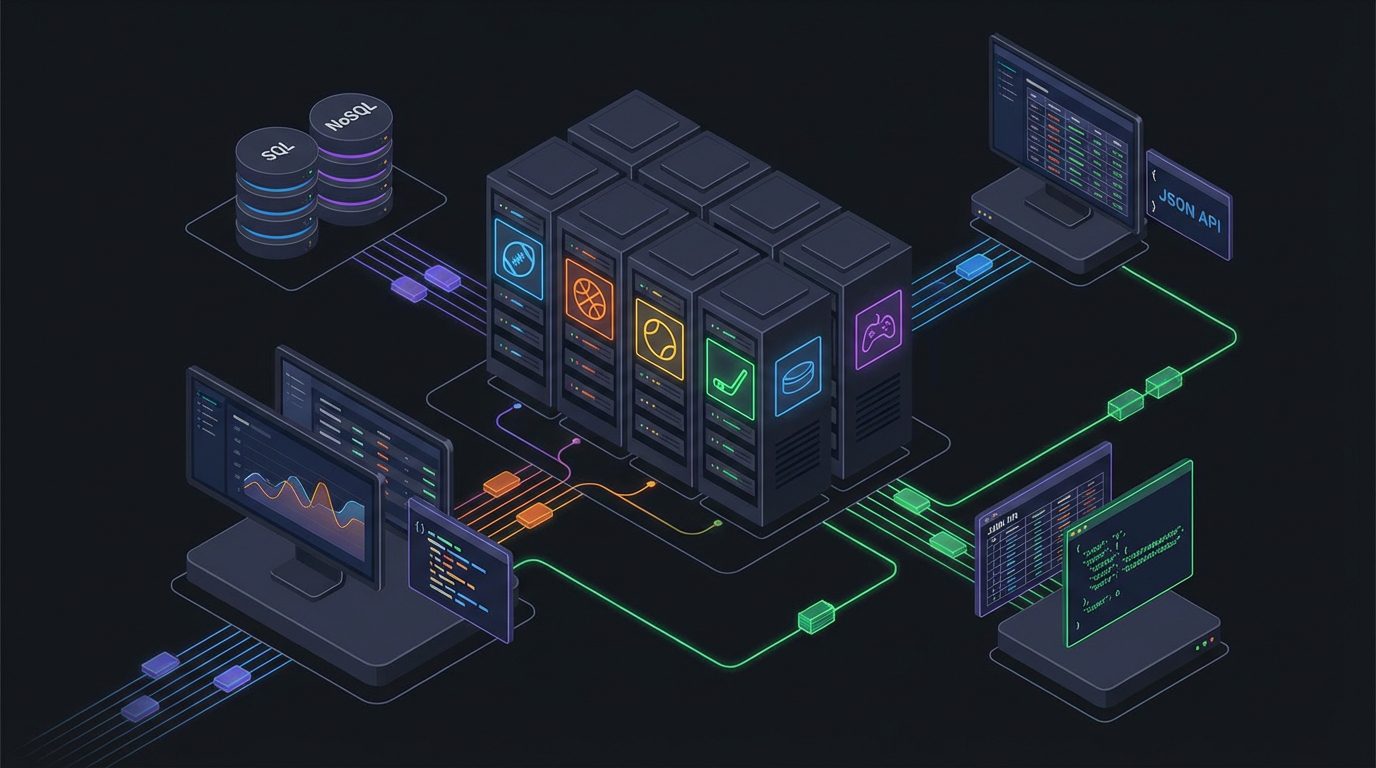
However, sports data is not limited to static information. Live events, detailed matchStatistics, streaming odds updates from oddsBase, API request logs, and telemetry form rapidly growing and loosely structured arrays. Here, NoSQL (MongoDB, Cassandra, ClickHouse, time-series or key-value stores) allows for flexible horizontal scaling, storing documents of any format, and efficiently processing time series. In conjunction with the sports event API, it is convenient to save raw JSON responses for matches and events in a document-oriented database, and then selectively project the data into a relational model for analytics and reporting.
In practice, the most resilient solutions are built as hybrids: SQL for critical reference tables and analytical dashboards, NoSQL for streams of live events, caches, and historical logs. This approach allows for quickly launching new sports, betting markets, and additional API fields without breaking the existing schema. Using a single data source — the Sport Events API based on api-sport.pro, You can simultaneously write data to both relational and document-oriented storage, gradually finding a balance between development speed and strict structure.
// Пример получения матчей по футболу и сохранения в вашу БД
fetch('https://api.api-sport.ru/v2/football/matches?date=2025-09-03', {
  headers: {
    'Authorization': 'ВАШ_API_KEY'
  }
})
  .then(r => r.json())
  .then(data => {
    data.matches.forEach(match => {
      // На этом шаге вы можете записать match
      // в SQL (таблица matches) и параллельно
      // сохранить полный JSON в NoSQL как "сырые данные"
      console.log(match.id, match.status, match.startTimestamp);
    });
  });
Architecture of a sports data warehouse for live results and analytics
Modern storage for sports data is usually built on a multi-level architecture. The first level is the integration layer with external sources, in our case with the REST API and the future WebSocket from api-sport.pro. Here, workers operate, which request matches, events, statistics, lineups, and odds on a schedule or in real-time. Raw responses are saved in a buffer NoSQL or file storage without transformations, so that processing can be replayed and history restored if necessary.
The second level is processing and normalization. Specialized services parse JSON from the Sport Events API and distribute entities across SQL tables: matches, players, teams, tournaments, seasons, betting markets. Some data, such as liveEvents and detailed matchStatistics, can simultaneously remain in document-oriented storage for flexible queries over time periods and quick visualization. The third level is analytical dashboards and cache: aggregated tables for dashboards, API gateway for internal services, in-memory cache (Redis/KeyDB) for popular queries, which minimizes latency when displaying live results to users.
An additional dimension of the architecture becomes the ML/AI layer and the upcoming WebSocket channel. Live data coming from the Sport Events API and bookmakers is streamed into prediction models, and the results are saved in separate showcases for client applications and partner services. With this approach, your system remains scalable: you can independently increase the capacity of the ingestion layer, analytical cluster, or API layer without affecting the rest of the infrastructure. To get started, it is enough to obtain a key in your personal account at api-sport.ru and embed the data loading pattern provided below.
// Упрощенный пример сервиса-загрузчика спортивных данных
async function loadLiveFootballMatches(apiKey) {
  const res = await fetch('https://api.api-sport.ru/v2/football/matches?status=inprogress', {
    headers: { 'Authorization': apiKey }
  });
  const json = await res.json();
  // rawStore.save(json);          // слой "сырых" данных (NoSQL / объектное хранилище)
  // sqlStore.syncMatches(json);   // нормализация в реляционные таблицы
  return json.totalMatches;
}
How to design an SQL schema for storing match, player, and team statistics
When designing the SQL schema for sports data, it is important to reflect the logic of the API itself. The entities used as a framework are: sport type, category (country/region), tournament, season, match, team, player. This is how the responses from the Sport Events API are structured, so the model in the database can be almost isomorphic to the JSON structure. This will simplify loading, subsequent migrations, and allow for the painless addition of new sports that periodically appear in the catalog api-sport.ru.
The base level consists of reference tables teams, players, tournaments, seasons, and the matches table, where key parameters are stored: status, date, timestamps, links to the tournament, season, and teams. For extensible match statistics, it is more convenient to use separate tables match_statistics and player_match_stats with a flexible structure (for example, a «key-value» pair or JSONB in PostgreSQL). This will allow storing complex groups of metrics from the matchStatistics field (shots, possession, duels, passes) without the need to rebuild the schema when new indicators appear.
Bookmaker odds (oddsBase) are recommended to be placed in a separate block of the schema: markets, market_choices (outcomes with odds), snapshots (history of odds changes). In this case, you will be able to store both current and starting values, as well as build time series for analyzing line movement. The linkage of relational tables with indexes on matchId, tournamentId, and update time will ensure fast queries for front-end widgets, internal analytical panels, and external partner integrations.
-- Упрощенный пример схемы матчей и команд
CREATE TABLE teams (
  id           BIGINT PRIMARY KEY,
  name         VARCHAR(255) NOT NULL,
  country      VARCHAR(128),
  sport_slug   VARCHAR(32)  NOT NULL
);
CREATE TABLE matches (
  id               BIGINT PRIMARY KEY,
  sport_slug       VARCHAR(32)  NOT NULL,
  tournament_id    BIGINT       NOT NULL,
  season_id        BIGINT       NOT NULL,
  start_timestamp  BIGINT       NOT NULL,
  status           VARCHAR(32)  NOT NULL,
  home_team_id     BIGINT       NOT NULL REFERENCES teams(id),
  away_team_id     BIGINT       NOT NULL REFERENCES teams(id)
);
CREATE TABLE match_statistics (
  match_id     BIGINT       NOT NULL REFERENCES matches(id),
  period       VARCHAR(16)  NOT NULL,
  group_name   VARCHAR(64)  NOT NULL,
  metric_key   VARCHAR(64)  NOT NULL,
  home_value   NUMERIC,
  away_value   NUMERIC,
  PRIMARY KEY (match_id, period, group_name, metric_key)
);
Using NoSQL for streaming sports data, events, and logs
NoSQL storage is ideal for working with streams of live events, logs, and high-frequency updates of odds. Each event from the endpoints /matches/{matchId} and /matches/{matchId}/events can be stored as a separate document containing match metadata, time-stamp, event type, score, and additional information. This approach scales well horizontally: as the number of tournaments, sports, and connected bookmakers grows, you simply add new shards and nodes to the cluster without touching the application.
For analyzing liveEvents and matchStatistics, document-oriented databases (MongoDB) or analytical systems with support for columnar and time-series storage (ClickHouse, Elasticsearch, time-series DBMS) are often chosen. Raw responses from the Sport Events API are placed in the collections «raw_matches,» «raw_events,» «raw_odds,» after which separate services form aggregates: the number of shots per minute, xG metrics, possession heat maps, etc. These collections are also convenient for debugging and auditing — you can always look at the raw data for a specific match and compare it with an external source.
Another important application of NoSQL is the collection and analysis of logs from your application and API calls: response time, request frequency by sports, number of authorization errors. A centralized log cluster helps quickly identify bottlenecks and optimize load. In conjunction with SQL dashboards, this provides a complete picture: from low-level events to high-level business metrics based on the same data you receive by key from the personal account api-sport.ru.
// Пример сохранения live-событий матча в NoSQL (псевдокод)
async function saveMatchEventsToMongo(apiKey, sportSlug, matchId, mongoCollection) {
  const url = `https://api.api-sport.ru/v2/${sportSlug}/matches/${matchId}/events`;
  const res = await fetch(url, { headers: { 'Authorization': apiKey } });
  const data = await res.json();
  const docs = data.events.map(ev => ({
    matchId: data.matchId,
    time: ev.time,
    type: ev.type,
    team: ev.team,
    player: ev.player,
    homeScore: ev.homeScore,
    awayScore: ev.awayScore,
    createdAt: new Date()
  }));
  await mongoCollection.insertMany(docs);
}
Sports event API: what data can be obtained and what to do with it
The Sport Events API based on api-sport.pro provides a complete data cycle for major sports: football, hockey, basketball, tennis, esports, table tennis, and many other disciplines. Through a single interface, you get a list of sports (/v2/sport), categories and tournaments, seasons, as well as detailed data on matches. For each match, statuses, time-stamps, team lineups, extended statistics matchStatistics, liveEvents, bookmaker odds oddsBase, and links to video highlights are available.
On top of this data, you can build virtually any products. For media — live result feeds, match cards with detailed statistics, calendar and tournament table widgets. For betting — line movement dashboards, alerts for odds changes, risk management systems, and custom analytical tools for users. For developers — internal recommendation services and personalized notifications for fans considering their favorite teams and leagues.
Thanks to the uniform structure of responses, extensible fields, and the rapid emergence of WebSocket streams and AI capabilities, you can focus on product logic rather than parsing hundreds of disparate sources. It is enough to integrate with the API once, set up regular loading of key endpoints (/matches, /matches/{matchId}, /players, /teams, /tournament/{id}), and design the storage described above. Subsequently, all new sports, tournaments, and statistical fields will automatically enter your system through the same API layer.
// Пример: получение детальной информации о матче и его событий
async function getMatchWithEvents(apiKey, sportSlug, matchId) {
  const [matchRes, eventsRes] = await Promise.all([
    fetch(`https://api.api-sport.ru/v2/${sportSlug}/matches/${matchId}`, {
      headers: { 'Authorization': apiKey }
    }),
    fetch(`https://api.api-sport.ru/v2/${sportSlug}/matches/${matchId}/events`, {
      headers: { 'Authorization': apiKey }
    })
  ]);
  const match = await matchRes.json();
  const events = await eventsRes.json();
  return {
    match,
    events: events.events
  };
}
Scaling and backing up the sports data warehouse and API
As the number of sports, tournaments, and users grows, the load on storage and API integration inevitably increases. For the SQL part, it is advisable to use horizontal read scaling (replicas), sharding by sports or categories, as well as indexing by matchId, tournamentId, and time fields. The NoSQL cluster scales by adding nodes and redistributing shards, allowing it to handle peaks of live traffic on days of major tournaments and finals without downtime.
Backup is a critical element of any sports platform. For relational databases, it is recommended to combine regular full backups, incremental copies, and a point-in-time recovery mechanism. Document-oriented and analytical storages can be duplicated in object storage (S3-compatible services) with versioning to be able to roll back to any state of the data. It is important to test recovery procedures on stands: merely having backups does not guarantee that the service can be quickly restored in a critical moment.
From the perspective of integration with the API, it is necessary to provide for smart caching, retries in case of network failures, rate limiting, and transitioning to WebSocket as it becomes available, in order to reduce the volume of polling.
// Пример безопасного вызова API с ретраями и логированием ошибок
async function safeApiCall(url, apiKey, maxRetries = 3) {
  for (let attempt = 1; attempt <= maxRetries; attempt++) {
    try {
      const res = await fetch(url, { headers: { 'Authorization': apiKey } });
      if (!res.ok) throw new Error(`HTTP ${res.status}`);
      return await res.json();
    } catch (err) {
      console.error('API error', { url, attempt, message: err.message });
      if (attempt === maxRetries) throw err;
      await new Promise(r => setTimeout(r, attempt * 1000)); // backoff
    }
  }
}