- What are dangerous moments in football and how to identify them through statistics
- What data from a football API is needed to track dangerous moments
- Overview of popular football APIs for automatic tracking of dangerous moments
- How to set up an algorithm for recognizing dangerous moments based on API data
- How to automatically receive notifications about goal-scoring moments through a football API
- Examples of integrating a football API into websites and applications for live analytics
What are dangerous moments in football and how to identify them through statistics
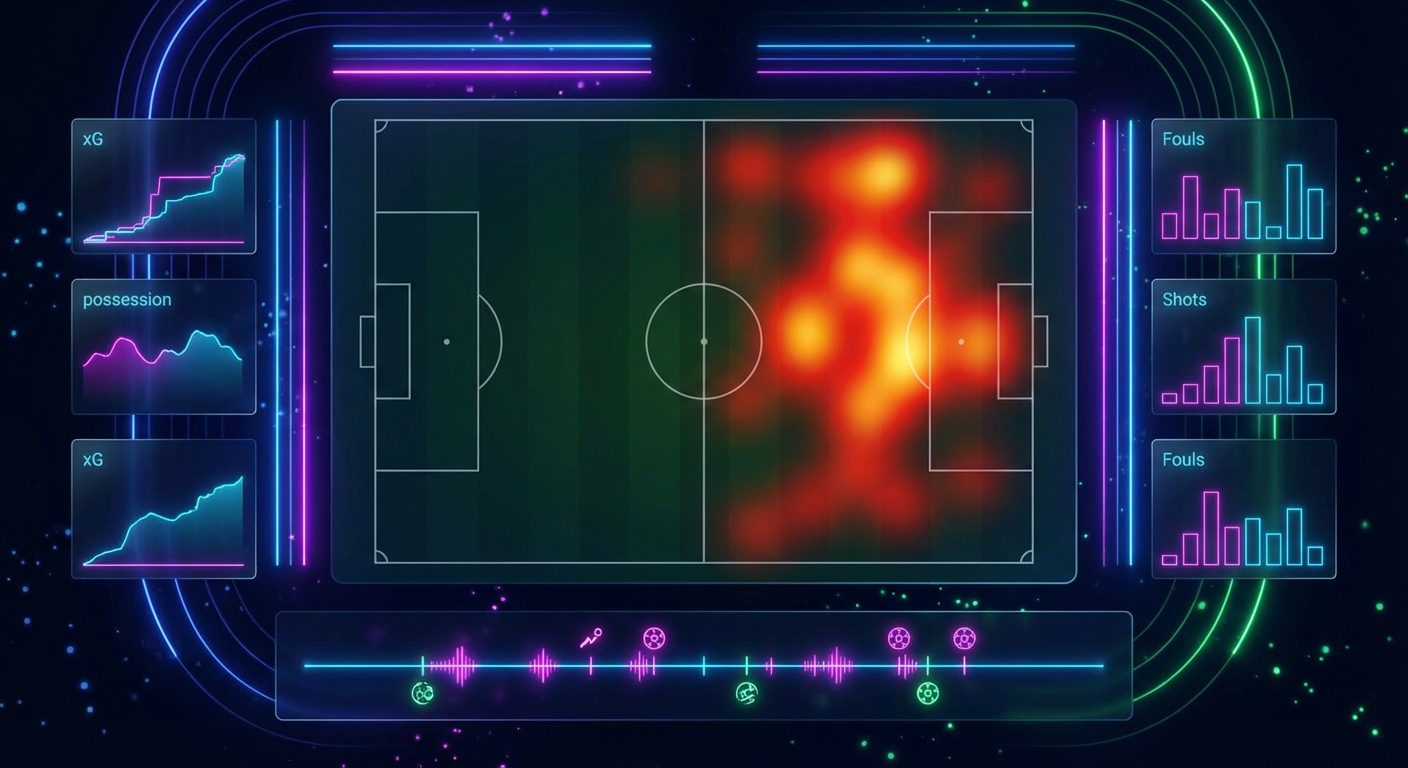
In professional analytics, a dangerous moment is understood as an episode in which the probability of a goal is significantly higher than the average attacking situation. This includes not only goals themselves but also shots from advantageous positions, one-on-one situations, penalties, follow-ups after a saved shot, and hitting the post. In expected goals (xG) models, such episodes are evaluated in terms of distance to the goal, angle of the shot, type of pass, and defensive density, and then translated into a numerical probability of scoring.
If we move from abstract descriptions to numbers, a dangerous moment is almost always reflected in specific statistical indicators of the match. In the data returned by modern football APIs, these are metrics such as shots on target, total shots, and touches in the penalty area, the Big chances indicator (created goal-scoring opportunities), converted and missed big chances, penalties, as well as related game events. When the number of such events noticeably increases over a short period, we observe a period of increased pressure on the goal and a series of dangerous moments.
Automatic identification of dangerous episodes essentially boils down to a formal description of football logic through thresholds for these indicators. For example, any appearance of a new Big chance, a sharp increase in shots on target or touches in the opponent’s penalty area, awarding a penalty, or a change in score can be considered a dangerous moment. This is how advanced analytical platforms and alert systems work: they continuously read statistics through the API, record changes, and mark an episode as a goal-scoring chance when specified conditions are met.
What data from a football API is needed to track dangerous moments
To automate the tracking of dangerous moments in live mode, it is important to use not just one, but several types of data from the football API. The basis consists of endpoints /v2/football/matches и /v2/football/matches/{matchId}, which return the match status, the field currentMatchMinute (current minute), array liveEvents with a timeline of key events, as well as extended statistics matchStatistics. In the statistics, you will find metrics such as Big chances (key field for goal moments), shots on goal and on target, shots and touches in the penalty area, goalkeeper saves, fouls in the final third, and other pressure indicators on the goal.
Special attention should be paid to the connection liveEvents + matchStatistics. The first provides triggers in the form of specific events (goal, penalty, VAR decision on a goal or penalty, cards), the second shows the dynamics of accumulated statistics over periods ALL, 1ST, 2ND. By comparing the values of the Big chances, shots on target, shots inside the box, touches in the penalty area between adjacent queries, one can accurately understand whether a new dangerous episode has emerged. Additionally, one can use the block oddsBase with bookmaker odds: sharp movements in live odds often coincide with peaks of dangerous moments and allow for a more refined logic of signals.
Below is an example of a request for current football matches with the status inprogress through the sports events API API-Sport and a selection of basic statistics for further analysis:
curl -X GET 'https://api.api-sport.ru/v2/football/matches?status=inprogress' \ -H 'Authorization: YOUR_API_KEY'
fetch('https://api.api-sport.ru/v2/football/matches?status=inprogress', { headers: { Authorization: 'YOUR_API_KEY' }}).then(r => r.json()).then(data => { const match = data.matches[0]; console.log('Минута матча:', match.currentMatchMinute); console.log('Live события:', match.liveEvents); console.log('Статистика матча:', match.matchStatistics);});[/code></div><div class="universal_article"><h2 id="contents-3">Обзор популярных футбольных API для автоматического трекинга опасных моментов</h2><p>Современные футбольные API можно условно разделить на три категории: событийные (live‑ивенты), статистические (расширенная пост и ин‑плей статистика) и букмекерские (рынки ставок и коэффициенты). Для качественного трекинга опасных моментов нужны все три слоя одновременно. События дают триггеры (гол, пенальти, VAR), статистика показывает накопленное давление, а коэффициенты букмекеров помогают оценить, насколько рынок согласен с тем, что эпизод был по‑настоящему опасным.</p><p><a href="https://api-sport.ru">Футбольный API API‑Sport</a> сочетает эти три направления в одном унифицированном интерфейсе. Через один и тот же набор эндпоинтов вы получаете: актуальный список видов спорта (<code>/v2/sport</code>), структуры турниров и сезонов, лайв‑матчи с полями <code>currentMatchMinute</code>, <code>liveEvents</code>, <code>matchStatistics</code>, а также блок <code>oddsBase</code> с котировками букмекеров и поле <code>highlights</code> с видеообзорами. Такой подход позволяет строить на одном стеке и системы алертов по опасным моментам, и дашборды для болельщиков, и аналитические инструменты для беттинга. При этом платформа развивается: скоро появится WebSocket‑доступ для push‑обновлений и AI‑сервисы для интеллектуальной оценки моментов.</p><p>Пример простого запроса к каталогу видов спорта, чтобы убедиться, что футбол доступен и посмотреть базовый путь к его данным:</p>[code lang='bash']curl -X GET 'https://api.api-sport.ru/v2/sport' \ -H 'Authorization: YOUR_API_KEY'
fetch(‘https://api.api-sport.ru/v2/sport’, { headers: { Authorization: ‘YOUR_API_KEY’ }}).then(r => r.json()).then(sports => { const football = sports.find(s => s.slug === ‘football’); console.log(‘Football is available at:’, football.apiBasePath);});
How to set up an algorithm for recognizing dangerous moments based on API data
The basic algorithm for recognizing dangerous moments can be built on the rule: we fix all new events of the type goal or penalty and track stepwise changes in key statistical metrics between requests. For this, a periodic polling of the endpoint is used. /v2/football/matches/{matchId}. At each step, you save the latest version matchStatistics и liveEvents, and in the next request, you compare them with the new data. If an event of the type goal, inGamePenalty or penaltyShootout, occurs, or the metrics Big chances, shots on target, shots inside box, or touches in penalty area have increased, the algorithm marks this interval as a dangerous moment.
In practice, it is convenient to break the task into three layers. The first layer is extracting the necessary numerical metrics from a complex structure matchStatistics (for the required period and key field, for example bigChanceCreated or shotsOnGoal). The second layer is storing and comparing previous values to understand how much the statistics have changed over the last interval. The third layer is a set of rules: for example, to consider any situation a dangerous moment when a new Big chance appears within one minute or two shots on target occur at once, or when VAR is reviewing a possible goal or penalty. This approach is easily extensible: you can add weighting coefficients, take into account the time of the match and the context of the score.
Below is an example of a simplified algorithm in JavaScript that takes a match by ID, extracts the necessary metrics, and determines whether a new dangerous moment has arisen between requests:
async function loadMatch(matchId) { const res = await fetch(`https://api.api-sport.ru/v2/football/matches/${matchId}`, { headers: { Authorization: ‘YOUR_API_KEY’ } }); return res.json();}function getStat(match, periodCode, key) { const period = match.matchStatistics.find(p => p.period === periodCode); if (!period) return 0; for (const group of period.groups) { const item = group.statisticsItems.find(i => i.key === key); if (item) return Number(item.homeValue) + Number(item.awayValue); } return 0;}let prevState = null;async function checkDanger(matchId) { const match = await loadMatch(matchId); const state = { minute: match.currentMatchMinute, bigChances: getStat(match, ‘ALL’, ‘bigChanceCreated’), shotsOnTarget: getStat(match, ‘ALL’, ‘shotsOnGoal’), shotsInBox: getStat(match, ‘ALL’, ‘totalShotsInsideBox’), eventsCount: match.liveEvents.length }; if (prevState) { const newEvents = match.liveEvents.slice(prevState.eventsCount); const hasCriticalEvent = newEvents.some(e => e.type === ‘goal’ || e.type === ‘inGamePenalty’ || e.type === ‘penaltyShootout’ || e.type === ‘varDecision’ ); const bigChanceDiff = state.bigChances — prevState.bigChances; const shotsOnTargetDiff = state.shotsOnTarget — prevState.shotsOnTarget; if (hasCriticalEvent || bigChanceDiff > 0 || shotsOnTargetDiff >= 2) { console.log(‘Обнаружен опасный момент на минуте’, state.minute); } } prevState = state;}setInterval(() => checkDanger(14570728), 10000);[/code>
How to automatically receive notifications about goal-scoring moments through a football API
After the algorithm for recognizing dangerous moments is set up, the next step is to turn it into a notification system for users or internal analysts. Architecturally, it looks like this: a separate service regularly requests match data through a football API, applies the rules for identifying dangerous episodes, and, when triggered, sends an event to external channels — push notifications in the app, webhooks to your backend, notifications in messengers, or e-mail. Thanks to the field currentMatchMinute and detailed liveEvents you can generate human-readable texts: specify the minute, type of moment (penalty, one-on-one, series of shots on target), and its context relative to the score.
The simplest implementation option is a background worker that polls the endpoint at a specified interval /v2/football/matches/{matchId}, uses the algorithm described above, and when triggered, writes the event to a queue or immediately calls an external API. A more advanced level is integration with a message broker and routing by client type: fans receive bright push notifications, the internal trading department receives a structured message with details of statistics and dynamics of odds from the block oddsBase. When the API supports WebSocket, it will be possible to abandon frequent polling and switch to push updates, which will reduce signal latency and load on the infrastructure.
Below is an example of a simplified service in Node.js that checks the match every 10 seconds and calls your webhook URL in case of a dangerous moment:
const WEBHOOK_URL = ‘https://your-service.com/danger-hook’;async function postWebhook(payload) { await fetch(WEBHOOK_URL, { method: ‘POST’, headers: { ‘Content-Type’: ‘application/json’ }, body: JSON.stringify(payload) });}let prevState = null;async function pollMatch(matchId) { const res = await fetch(`https://api.api-sport.ru/v2/football/matches/${matchId}`, { headers: { Authorization: ‘YOUR_API_KEY’ } }); const match = await res.json(); const eventsCount = match.liveEvents.length; if (prevState && eventsCount > prevState.eventsCount) { const newEvents = match.liveEvents.slice(prevState.eventsCount); const hasGoalOrPenalty = newEvents.some(e => e.type === ‘goal’ || e.type === ‘inGamePenalty’ || e.type === ‘penaltyShootout’ ); if (hasGoalOrPenalty) { await postWebhook({ matchId, minute: match.currentMatchMinute, score: `${match.homeScore.current}:${match.awayScore.current}`, type: ‘dangerous_moment’, events: newEvents }); } } prevState = { eventsCount };}setInterval(() => pollMatch(14570728), 10000);[/code]
Examples of integrating a football API into websites and applications for live analytics
The practical value of automatic tracking of dangerous moments manifests when you embed it into real interfaces. For sports media and portals, this can be live centers with a timeline, where goal episodes are highlighted as a separate layer, and when clicking on a marker on the timeline, the user sees detailed statistics and a link to highlights from the field highlights. For betting projects, such a layer helps traders and users see phases of high pressure, correlating them with the dynamics of odds from oddsBase and respond more quickly to changes in risks.
In mobile applications, it is convenient to implement personal subscriptions: the user selects teams or tournaments, and the backend, based on data from the football API, tracks matches with the necessary filters (tournament_id, team_id, status=inprogress) and sends notifications only for truly dangerous moments. All these scenarios rely on the same endpoints, and the integration process begins with registration at the personal account. and obtaining an API key, which is passed in the header Authorization with each request.
Below is an example of frontend integration: a simple live analytics widget that shows the current minute, score, and counter of dangerous moments based on Big chances. Such a block can be embedded in any website or admin panel:
async function loadLiveMatch(matchId) { const res = await fetch(`https://api.api-sport.ru/v2/football/matches/${matchId}`, { headers: { Authorization: ‘YOUR_API_KEY’ } }); return res.json();}function getBigChancesTotal(match) { const periodAll = match.matchStatistics.find(p => p.period === ‘ALL’); if (!periodAll) return 0; for (const group of periodAll.groups) { const item = group.statisticsItems.find(i => i.key === ‘bigChanceCreated’); if (item) return Number(item.homeValue) + Number(item.awayValue); } return 0;}async function renderWidget(matchId) { const match = await loadLiveMatch(matchId); const minute = match.currentMatchMinute; const score = `${match.homeScore.current}:${match.awayScore.current}`; const bigChances = getBigChancesTotal(match); document.getElementById(‘minute’).textContent = minute; document.getElementById(‘score’).textContent = score; document.getElementById(‘dangerCount’).textContent = bigChances;}setInterval(() => renderWidget(14570728), 15000);[/code>
Thus, a unified football API allows not only to count dangerous moments but also to turn them into visual products: live dashboards, alert systems, internal analytical interfaces, and tools for working with bookmakers. As WebSocket and AI services emerge in the API-Sport ecosystem, the quality and speed of such solutions will only increase.